
The router is in the living room, the office is on the second floor, and the bedroom at the far end of the hallway has been streaming at 480p since the day you moved in. In a large home, no single router can win against walls, floors, and distance. Mesh Wi-Fi fixes this with multiple nodes that share one network, so you walk from room to room without switching networks or losing the signal. The challenge is choosing between dual-band and tri-band systems, Wi-Fi 6 and 6E, and coverage claims that assume perfect open floor plans. This guide covers the best mesh Wi-Fi systems for large homes in 2026 with realistic advice.

Quick verdict
For most large homes, the TP-Link Deco XE75 is the best value: tri-band Wi-Fi 6E with a dedicated backhaul band, easy setup, and strong whole-home coverage in a three-pack. If you want the absolute simplest system, the eero 6+ gets the job done with less jargon. For the largest properties and the best performance per node, the Netgear Orbi 770 is the premium choice.
Who this guide is for
This guide is for owners of large, multi-level homes where Wi-Fi dies in at least one room, households with several people streaming and working at the same time, and anyone who has already tried moving the router and buying a range extender without success.
Who should skip these picks
Skip mesh if your home is under about 1,500 square feet and a good single router covers it, since you will pay for capacity you do not use. Skip premium tri-band systems if your internet plan is under 300 Mbps, where a budget dual-band mesh delivers the same real-world speeds. And if your problem is a single dead corner, try repositioning the router or a powerline adapter before spending on a full mesh.
Best mesh Wi-Fi systems for large homes
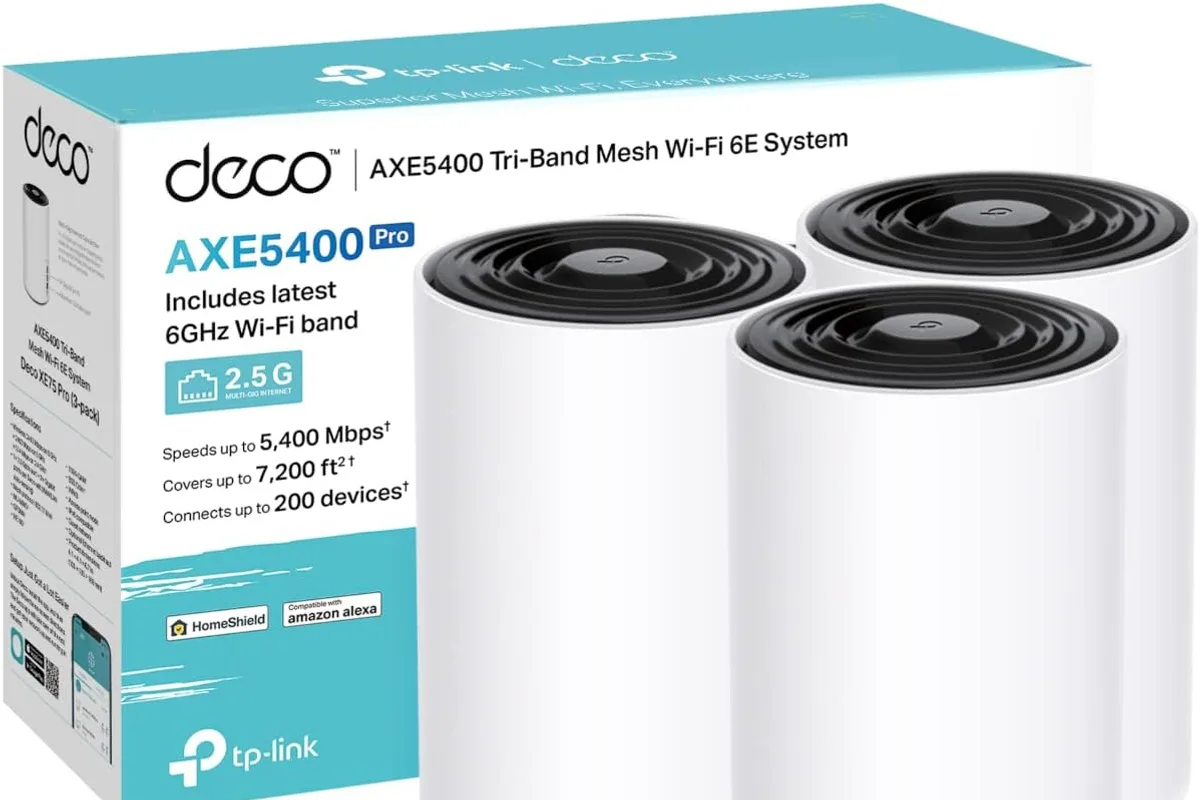
1. TP-Link Deco XE75 — best overall value
TP-Link Deco XE75
Best mesh Wi-Fi 6E system for large homesWhy it works
- AXE5400 tri-band mesh with dedicated backhaul band
- Covers up to 5,500 square feet in a three-pack
- Seamless roaming and app-based parental controls
- Works with Amazon Alexa and Google Assistant
Tradeoffs
- Great whole-home coverage
- Easy mesh setup
- Good value
- No 2.5G ports on every unit
- One unit can be enough for smaller homes
The Deco XE75 hits the sweet spot for large homes because it solves the two problems that matter: coverage and satellite speed. The tri-band AXE5400 design reserves one band for backhaul, so the node in the home office does not steal airtime from your phone. Setup through the Deco app takes minutes, and the three-pack covers most large homes with seamless roaming. It supports Wi-Fi 6E for newer devices and works with Alexa and Google Home. The main compromise is the lack of 2.5G ports on every node, which only matters on gigabit-plus plans.
2. Amazon eero 6+ — best for simplicity
Amazon eero 6+
Best beginner-friendly mesh systemWhy it works
- Tri-band Wi-Fi 6 with gigabit-capable ethernet ports
- TrueMesh technology for automatic path selection
- App setup in minutes with ongoing profile controls
- Works with Alexa, Matter, and Thread
Tradeoffs
- Extremely simple
- Compact nodes
- Reliable automatic updates
- Advanced features require eero Plus
- No Wi-Fi 6E
The eero 6+ is the mesh for people who want to install it, forget it, and never look at a network settings page again. The app guides you through placement, TrueMesh automatically picks the best path between nodes, and the small white pucks disappear into any room. It is tri-band Wi-Fi 6 with gigabit ports, which comfortably handles a 500 Mbps plan across a large home. Advanced security and parental controls require the eero Plus subscription, but the core mesh coverage is complete without it.
3. Netgear Orbi 770 — best premium performance
Netgear Orbi 770
Best premium mesh for very large homesWhy it works
- Wi-Fi 7-ready tri-band mesh with 10G port on the router
- Covers up to 7,700 square feet in a three-pack
- Dedicated backhaul for stable satellite speeds
- Armor security with parental controls
Tradeoffs
- Excellent range
- Future-proof 10G port
- Strong throughput
- Expensive
- Armor subscription for advanced security
The Orbi 770 is the pick when you want the best satellite performance money can buy and a system that will not feel dated in a few years. It is a Wi-Fi 7-ready tri-band mesh with a dedicated backhaul band and a 10G port on the router for future gigabit-plus service. The three-pack covers very large homes, and each satellite includes ethernet ports for wired devices like a home office dock or a TV. It is expensive and its advanced security is subscription-based, but for a big house with heavy use it is the most future-proof choice.
Comparison table
| System | Best for | Class | Backhaul | Coverage (3-pack) | 2.5G/10G port |
|---|---|---|---|---|---|
| Deco XE75 | Overall value | AXE5400 | Dedicated | ~5,500 sq ft | No |
| eero 6+ | Simplicity | AX3000 | Tri-band | ~4,500 sq ft | No |
| Orbi 770 | Premium large homes | Wi-Fi 7 | Dedicated | ~7,700 sq ft | 10G router port |
How to choose a mesh system
Start by measuring the problem: which rooms are weak, and is the home one level or multiple? That tells you how many nodes you need and whether a dedicated backhaul band is worth paying for. Multi-level homes and heavy streaming benefit most from tri-band systems, because satellite nodes stay fast when they are not sharing the same band as your devices.
Next, match the system to your internet plan. On a 500 Mbps plan, a Wi-Fi 6 mesh with gigabit ports is enough. On gigabit fiber, look for at least one 2.5G port so the router can feed the network without capping it. Finally, check that every node has an ethernet port; wired backhaul or a hardwired satellite is the best way to guarantee full speed in the rooms that matter.
What not to overpay for
Do not buy a three-pack when two nodes cover your home; add a third only if a corner stays weak. Do not pay for Wi-Fi 7 until your devices and internet plan can use it. And avoid systems that hide basic features like per-device controls behind a subscription, unless you actually want those features. Coverage is the product; everything else should be judged against your plan speed and home layout.
Final verdict
Start with the Deco XE75 three-pack for most large homes, choose the eero 6+ if simplicity wins, and step up to the Orbi 770 if you have gigabit-plus service or want maximum future-proofing. Place the first node centrally, keep satellites within range of each other, and run a speed test in every room before you decide whether you need that third node after all.